
Key Takeaways
Key Takeaways
- Option buyers need movement, timing, and volatility.
- Option writers often benefit from time decay and controlled movement.
- Nifty and Bank Nifty can behave differently when writers dominate positioning.
- Open interest helps identify where the battle is concentrated.
- Traders should read options data as context, not as certainty.
Two Different Games
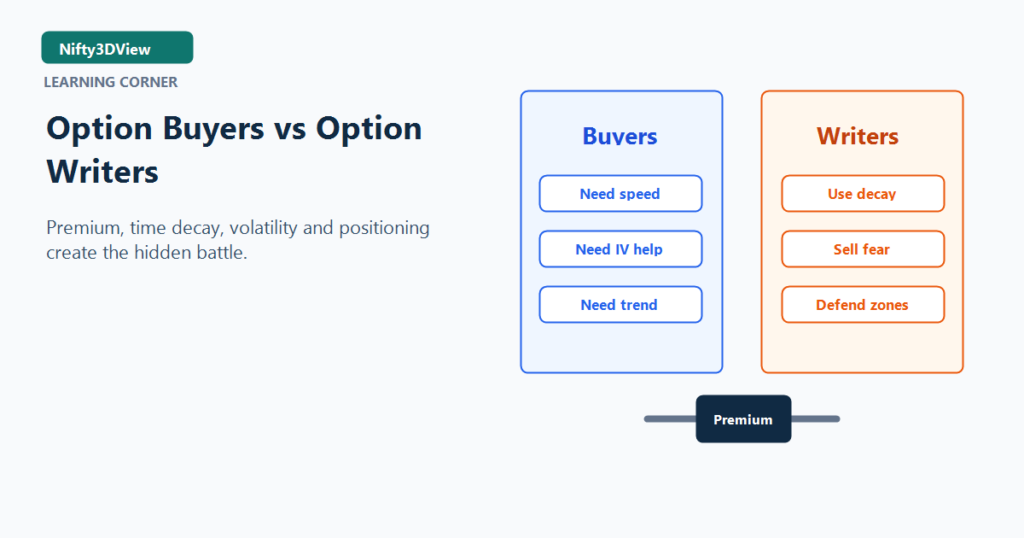
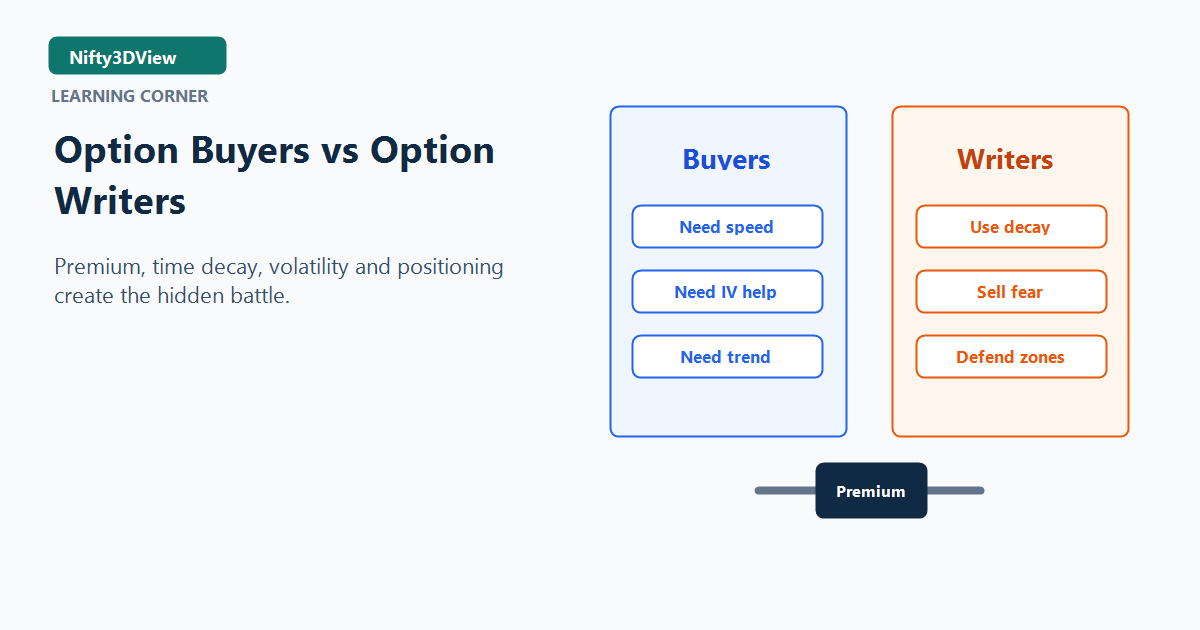
Option buyers and option writers are not playing the same game.
An option buyer usually wants a fast move in the expected direction. The buyer pays premium and needs the move to happen before time decay damages the position.
An option writer sells premium. The writer may benefit if price stays controlled, volatility falls, or time passes without a large adverse move.
This creates a constant battle around strikes.
Why Buyers Struggle
Option buying is emotionally attractive because the maximum loss is known and the upside can look large.
But buyers fight three enemies:
- direction can be wrong
- timing can be wrong
- volatility can collapse
A trader can be directionally right and still lose money if the move is late or the premium was too expensive.
Why Writers Are Not Always Safe
Option writing looks calm until it is not.
Writers can benefit from time decay, but they carry risk when price moves sharply. Near expiry or near important strikes, writers may need to hedge quickly. That can create sudden index movement.
So writers are not all-powerful. They are influential, but they are also forced to adjust when price moves against them.
How This Shows Up On The Chart
When writers dominate:
- price may stay range-bound
- movement may fade near heavy strikes
- breakouts may fail without strong flow
- volatility may compress
When buyers or hedging pressure takes control:
- price can expand quickly
- stops can trigger
- volatility can jump
- option premiums can reprice fast
What To Watch In The Option Chain
Useful observations:
- where call open interest is concentrated
- where put open interest is concentrated
- whether OI is building or unwinding
- whether PCR is extreme or balanced
- whether price is accepting above or below key strikes
- whether volatility is expanding or compressing
No single reading is enough. Combine option-chain context with price, breadth, and regime.
The Risk Desk Interpretation
The Risk Desk does not ask, "Who will win, buyers or writers?"
It asks:
- where is positioning concentrated?
- what would force adjustment?
- does price confirm the option-chain message?
- is the market regime supportive?
- should this be action, review, or rejection?
That is a more stable way to use options data.
For application, review the Risk Desk sample, check the latest market view, or join Risk Desk beta updates.
Continue The Modern Market Structure Series
- The New Market Reality: Why Technical Analysis Needs Market Structure in 2026
- Expiry Day Physics: How Option Writers Shape Nifty Movement
- Why Breakouts Fail: Liquidity, Stops and Crowded Trades
- The Hidden Battle Between Option Buyers and Option Writers
- Who Really Moves the Market: Retail, FIIs, DIIs, Algos or Option Writers?
- The Nifty Market Map: A Complete Framework for Reading Indian Markets
Risk Warning
Options involve complex risk. Option-chain analysis should be treated as market context, not a standalone trading signal.