
Key Takeaways
Key Takeaways
- No single participant group controls the market all the time.
- FIIs and DIIs matter, but their impact depends on regime, liquidity, and index weight.
- Retail traders can influence short-term options behavior, especially around crowded levels.
- Algorithms can accelerate movement when many systems react to the same triggers.
- Option writers can shape index behavior near expiry and important strikes.
The Wrong Question
Many traders ask, "Who is moving the market today?"
A better question is, "Which participant matters most in this condition?"
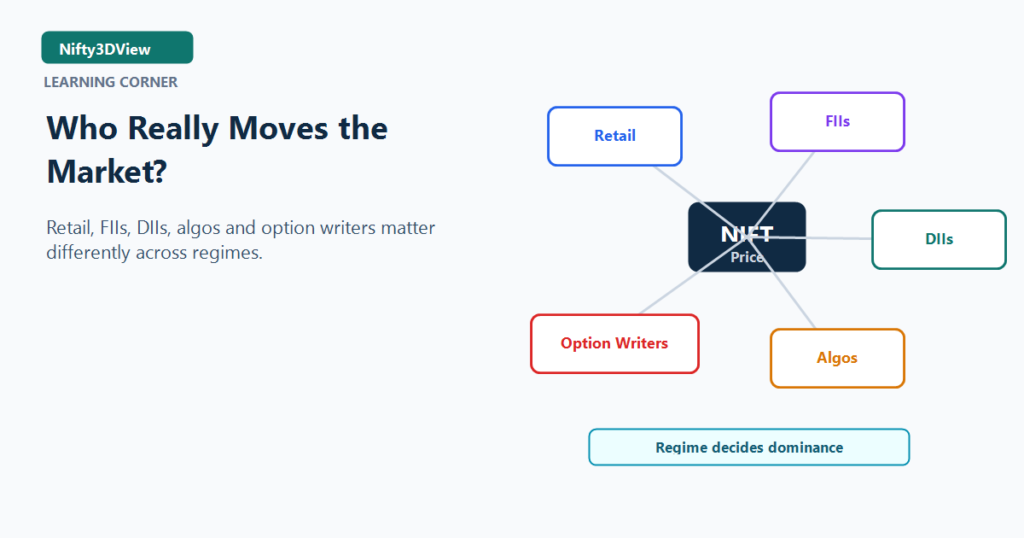
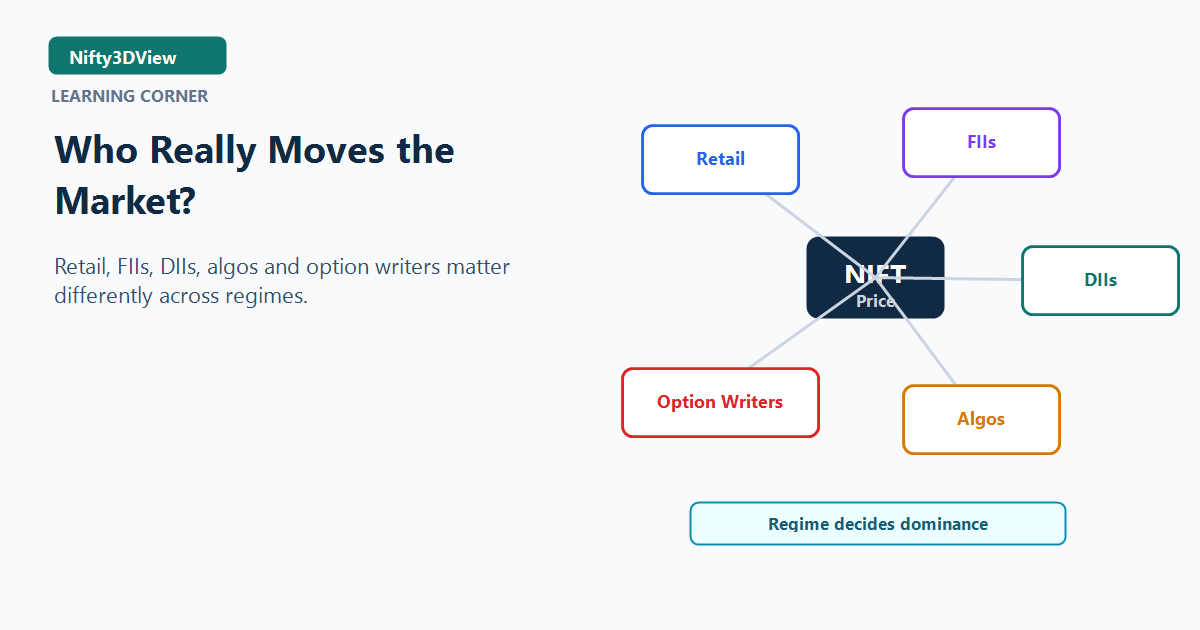
The answer changes. On some days, institutional flow dominates. On some days, expiry positioning dominates. On some days, global cues matter more. On some days, the market is simply digesting previous movement.
Retail Traders
Retail participation adds speed and emotion to the market.
Retail traders often cluster around:
- round numbers
- popular chart patterns
- option strikes
- social-media narratives
- recent winners and losers
Retail flow can matter most in short-term options, momentum bursts, and crowded intraday levels. But retail flow alone does not usually sustain a major trend without broader support.
FIIs
Foreign institutional investors can influence trend, liquidity, and sentiment, especially in index-heavy names.
Their impact often shows up through:
- cash market flows
- index futures positioning
- currency sensitivity
- global risk appetite
- large-cap leadership
But FII data should not be read in isolation. A single day of buying or selling is less useful than the trend and the market's reaction to it.
DIIs
Domestic institutional investors can provide stability when foreign flows are weak. They may absorb selling, rotate into preferred sectors, or support broader market sentiment.
DII behavior matters because domestic flows can reduce panic and support longer-term participation.
Algorithms
Algorithms do not always create the original idea, but they can accelerate execution.
They may react to:
- price breaks
- volume spikes
- option levels
- volatility changes
- global market movement
- news and data events
When many systems react to similar triggers, a small move can become sharp.
Option Writers
Option writers can influence index behavior around important strikes. Their presence can contribute to pinning, range-bound movement, and sudden adjustments when price breaks a defended zone.
This is why a trader should not look at Nifty and Bank Nifty levels without checking option-chain context.
How To Read The Participants Together
| Condition | Participant To Watch More Closely |
|---|---|
| Trend day | FIIs, sector leadership, breadth |
| Expiry day | Option writers, OI shifts, volatility |
| Range day | Writers, breadth, volatility compression |
| News day | Global cues, algos, institutional reaction |
| Panic day | FIIs, DIIs, volatility, breadth |
| False breakout day | Retail crowding, liquidity, stops |
Risk Desk View
Risk Desk thinking does not worship one data point. It layers participants.
The question is not whether retail, FIIs, DIIs, algos, or writers are "right." The question is whether their combined behavior supports action, review, or rejection.
That is why a setup can look attractive on price and still be rejected by broader context.
Study the Risk Desk sample, check the latest market view, or join Risk Desk beta updates.
Continue The Modern Market Structure Series
- The New Market Reality: Why Technical Analysis Needs Market Structure in 2026
- Expiry Day Physics: How Option Writers Shape Nifty Movement
- Why Breakouts Fail: Liquidity, Stops and Crowded Trades
- The Hidden Battle Between Option Buyers and Option Writers
- Who Really Moves the Market: Retail, FIIs, DIIs, Algos or Option Writers?
- The Nifty Market Map: A Complete Framework for Reading Indian Markets
Risk Warning
Participant-flow interpretation is uncertain. It should be combined with risk control and independent judgment.