
Key Takeaways
Key Takeaways
- A breakout is not confirmed just because price crosses resistance.
- Failed breakouts often happen when the move is crowded, weakly supported, or into poor liquidity.
- Stop clusters can attract price before reversal.
- Breadth, volume, volatility, and open interest help judge whether a breakout has quality.
- The best traders do not chase every breakout. They filter aggressively.
The Breakout Illusion
Breakouts are attractive because they look simple. Price crosses resistance, traders enter, and the move should continue.
Reality is not that clean.
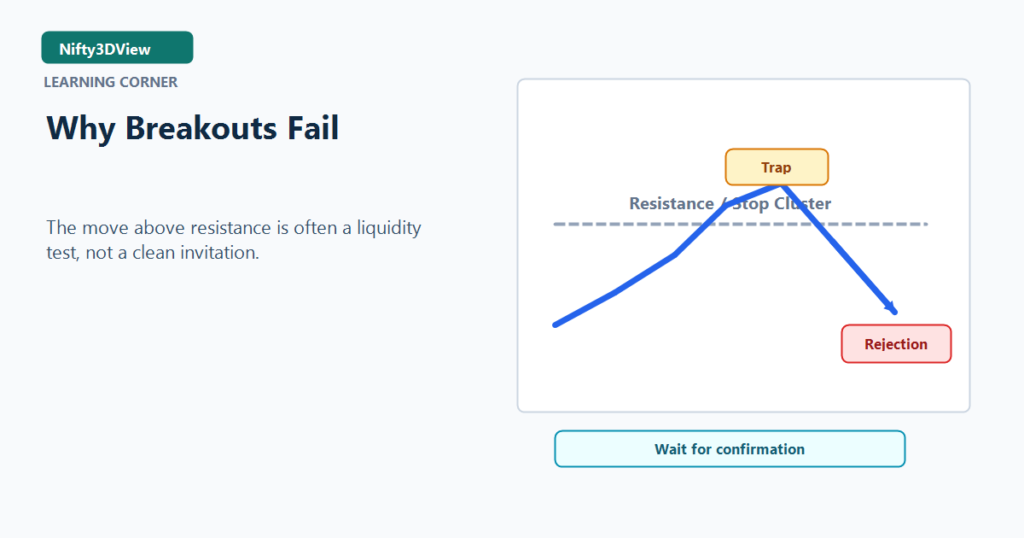
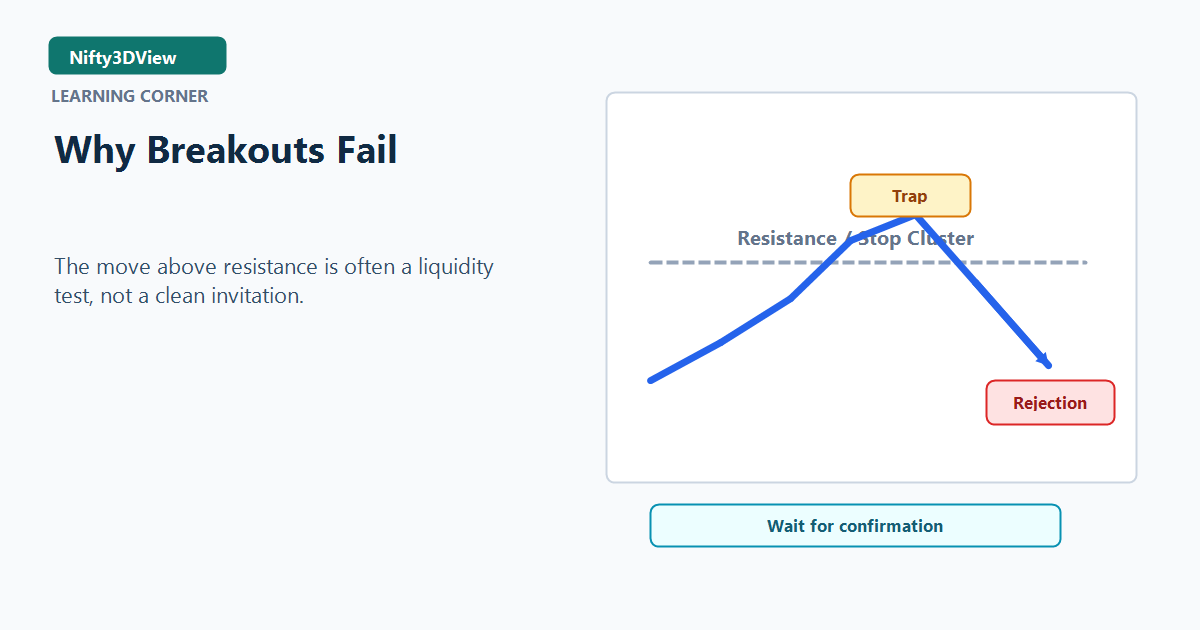
Many breakouts fail because the market knows where traders are watching. Obvious levels attract attention. Attention creates orders. Orders create liquidity. Liquidity attracts larger participants and faster systems.
That is why a breakout can become a trap.
What A Real Breakout Needs
A strong breakout usually needs more than price movement.
It needs:
- follow-through after the level breaks
- broad participation
- volume confirmation
- supportive market regime
- clean volatility expansion
- lack of heavy option resistance
- no immediate reversal back into the old range
If price breaks out but the supporting layers are weak, the move is fragile.
Liquidity Grabs
A liquidity grab happens when price moves beyond an obvious level, triggers orders, and then reverses.
This can happen above resistance or below support. Traders who enter late get trapped. Traders who had stop losses around that level get taken out.
The point is not to imagine a conspiracy behind every failed breakout. The point is to understand that obvious levels attract order flow, and order flow can create short-lived movement.
Stop Clusters
Retail traders often place stops in similar locations:
- just below swing lows
- just above swing highs
- below round numbers
- above obvious resistance
- below obvious support
When many stops sit near the same zone, price can move there quickly. After the stops trigger, there may be no follow-through demand or supply. That is when reversal begins.
Crowded Trades
A crowded trade is a setup too many people are already watching.
Signs of crowding:
- everyone on social media discusses the same level
- option activity is concentrated at nearby strikes
- price has tested the same level many times
- breakout happens without breadth support
- candles expand suddenly after a long wait
Crowding does not mean the setup must fail. It means the setup needs stronger confirmation.
Better Breakout Checklist
Before trusting a breakout, ask:
- Did price close beyond the level or only spike through it?
- Did breadth confirm?
- Did volume expand with quality?
- Is the market regime supportive?
- Is the breakout moving into heavy call or put writing?
- Is volatility expanding cleanly?
- Is the stop placement obvious?
- What happens if price comes back inside the range?
Risk Desk View
Risk Desk thinking treats a breakout as a candidate, not a conclusion.
A breakout can be placed into one of three buckets:
| Bucket | Meaning |
|---|---|
| Action-quality | Multiple layers confirm |
| Review-only | Price is interesting, but context is incomplete |
| Reject | Risk, regime, or confirmation is weak |
Most poor trades come from treating review-only setups as action-quality setups.
Use the Risk Desk sample to see rejection logic in practice. For current context, start with the latest market view or join Risk Desk beta updates.
Continue The Modern Market Structure Series
- The New Market Reality: Why Technical Analysis Needs Market Structure in 2026
- Expiry Day Physics: How Option Writers Shape Nifty Movement
- Why Breakouts Fail: Liquidity, Stops and Crowded Trades
- The Hidden Battle Between Option Buyers and Option Writers
- Who Really Moves the Market: Retail, FIIs, DIIs, Algos or Option Writers?
- The Nifty Market Map: A Complete Framework for Reading Indian Markets
Risk Warning
Breakout analysis is uncertain. A clean-looking chart can still fail if market structure does not support the move.