
Key Takeaways
Key Takeaways
- Expiry movement is often shaped by option positioning, not only by chart levels.
- Max pain is a reference point, not a magnet that must always work.
- Nifty can look stuck when writers defend zones, then move sharply when positioning adjusts.
- Gamma pressure can make small price moves expand quickly near key strikes.
- Expiry-day trading needs extra discipline because noise can look like signal.
Why Expiry Feels Different
Expiry days often feel strange to traders. Price may spend hours inside a narrow band, ignore normal chart signals, then suddenly move 80 or 100 points in a short burst.
This happens because expiry is not only about direction. It is also about positioning.
Option buyers want movement. Option writers usually prefer controlled movement, time decay, and price staying away from their sold strikes. When both sides are active near the same index levels, the market can behave like a compressed spring.
Option Writers And The Pinning Effect
Option writers collect premium by selling options. Their risk increases if price moves too far against the strike they sold.
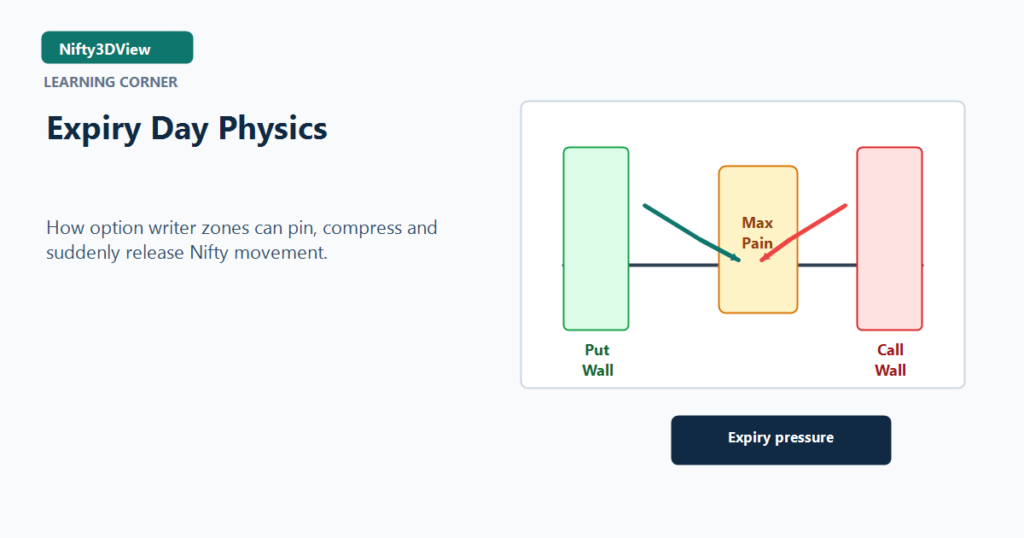
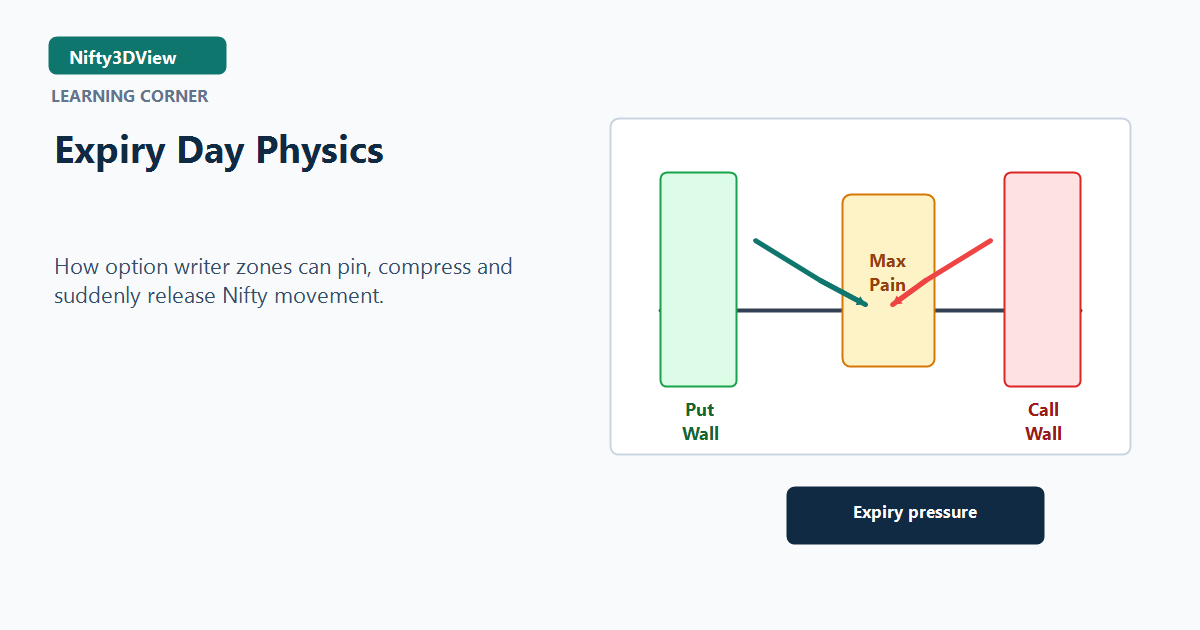
When large open interest builds around specific strikes, those levels can become pressure zones. Price may appear to get pinned near a strike because writers defend positions, hedgers adjust, and short-term traders react to the same level.
Pinning is not magic. It is a temporary balance of incentives.
Max Pain: Useful, But Misunderstood
Max pain is often described as the level where option buyers lose the most money at expiry. Many traders treat it like a guaranteed destination. That is risky.
Max pain can help identify where positioning is concentrated, but it does not override:
- strong trend days
- unexpected news
- institutional flow
- volatility expansion
- forced hedging
- aggressive unwinding
Use max pain as a context marker, not a trading signal by itself.
Why Sudden Moves Happen
A sudden move can happen when one side is forced to adjust quickly.
For example:
- price breaks a defended strike
- writers start hedging
- stop losses trigger
- option buyers chase momentum
- volatility expands
- algos react to the same level
The result can look like a surprise, but often the pressure was building earlier.
Gamma Pressure In Simple Words
Gamma describes how quickly option sensitivity changes as price moves. You do not need to become an options mathematician to understand the practical effect.
Near expiry, small index moves around important strikes can force fast hedging. That hedging can add fuel to the move. This is why expiry price action can go from boring to violent.
Expiry Day Checklist
Before interpreting a move, ask:
- Which strikes have heavy open interest?
- Is price near a known option-writing zone?
- Is PCR confirming or warning?
- Is volatility expanding?
- Is breadth supporting the index move?
- Is the move happening near the final expiry hours?
- Am I trading signal or reacting to noise?
How Risk Desk Reads Expiry
Risk Desk thinking does not treat expiry levels as predictions. It treats them as decision zones.
A strike can matter because many traders are positioned there. But the correct question is not "Will Nifty go to max pain?" The better question is "What happens if price accepts above or below this zone?"
That is the difference between prediction and scenario planning.
Read the latest market view, study the Risk Desk sample, or join Risk Desk beta updates.
Continue The Modern Market Structure Series
- The New Market Reality: Why Technical Analysis Needs Market Structure in 2026
- Expiry Day Physics: How Option Writers Shape Nifty Movement
- Why Breakouts Fail: Liquidity, Stops and Crowded Trades
- The Hidden Battle Between Option Buyers and Option Writers
- Who Really Moves the Market: Retail, FIIs, DIIs, Algos or Option Writers?
- The Nifty Market Map: A Complete Framework for Reading Indian Markets
Risk Warning
Expiry-day analysis can change quickly. Option-chain context is useful, but it should not be treated as a guaranteed trading edge.